Mingle254 Blog
Attachment Styles in Relationships: Secure, Anxious, Avoidant Explained
🧠 Attachment Styles in Relationships (And How They Affect Love)
Introduction: Why You Love the Way You Do
Have you ever wondered:
- Why you get attached quickly?
- Why you overthink in relationships?
- Why some people seem distant or avoid closeness?
👉 It’s not random.
It’s often influenced by something called:
Attachment styles
These are patterns that shape:
- How you connect
- How you communicate
- How you respond to love and conflict
👉 And they often come from:
Early life experiences.
If you’ve ever felt confused in relationships, this may explain it: 👉 Why You Keep Attracting the Wrong People (And How to Fix It)
What This Guide Will Help You Do
- Understand the 4 main attachment styles
- Recognize your own patterns
- Improve your relationships through awareness
🧠 What Are Attachment Styles?
Attachment styles are:
The way you form emotional bonds with others.
They influence:
- How you give and receive love
- How you handle conflict
- How secure or insecure you feel in relationships
Your attachment style shapes how you experience love.
If you want to build healthier relationship patterns, start here: 👉 What Makes a Relationship Truly Healthy? (Complete Guide)
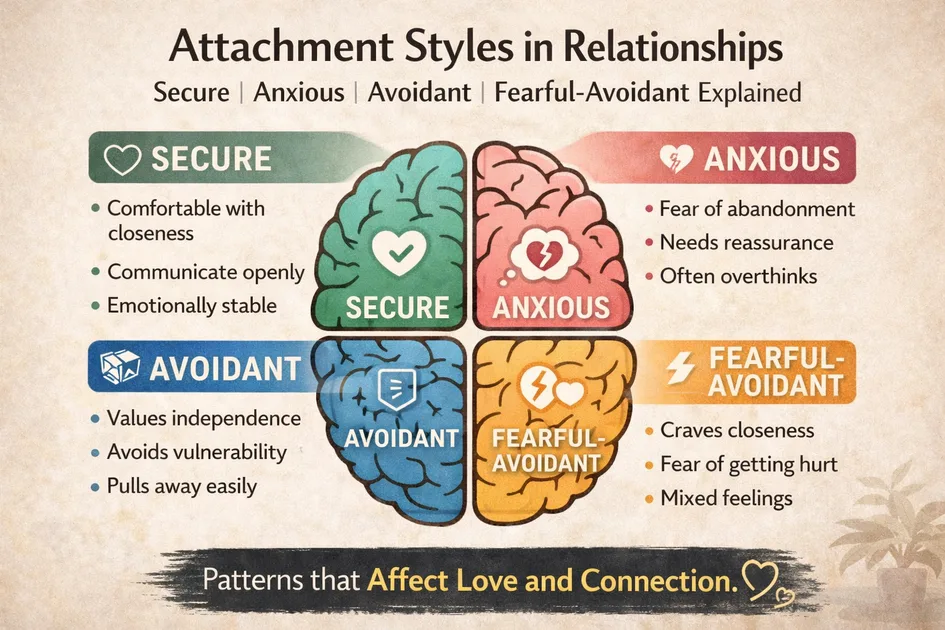
❤️ The 4 Main Attachment Styles
🌱 1. Secure Attachment
💞 Traits:
- Comfortable with closeness
- Trusting
- Communicates openly
- Emotionally stable
👉 They feel safe in relationships.
❤️ In relationships:
- Handle conflict well
- Give and receive love easily
This is the healthiest style.
💭 2. Anxious Attachment
💞 Traits:
- Fear of abandonment
- Need for reassurance
- Overthinking
- Emotional sensitivity
💔 In relationships:
- May feel insecure
- Seek constant validation
They love deeply — but often feel anxious.
If this sounds like you, this may help: 👉 How to Handle Social Anxiety in Dating (Without Losing Yourself)
🧊 3. Avoidant Attachment
💞 Traits:
- Emotionally distant
- Values independence strongly
- Avoids vulnerability
💔 In relationships:
- Struggles with closeness
- Pulls away when things get serious
They protect themselves by staying distant.
If you’ve experienced this in a partner, read: 👉 Emotionally Unavailable Partner: Signs, Causes, and What to Do
⚡ 4. Fearful-Avoidant (Disorganized)
💞 Traits:
- Wants closeness but fears it
- Mixed signals
- Emotional inconsistency
💔 In relationships:
- Push-pull behavior
- Confusion
They struggle with both trust and vulnerability.
If this dynamic feels familiar, this may help: 👉 Nonchalant Partners: What It Means and How to Deal With It (Complete Guide)
⚖️ How Attachment Styles Affect Relationships
💔 Anxious + Avoidant Pairing
- One seeks closeness
- The other pulls away
👉 Creates a cycle of frustration.
❤️ Secure + Any Style
- Secure partner provides stability
👉 Helps create balance.
💭 Anxious + Anxious
- Intense emotions
- High dependency
🧊 Avoidant + Avoidant
- Lack of emotional depth
- Distance
Compatibility depends on awareness and effort.
🛠️ How to Identify Your Attachment Style
Ask yourself:
- [ ] Do I fear being abandoned?
- [ ] Do I avoid emotional closeness?
- [ ] Do I feel secure and stable?
- [ ] Do I send mixed signals?
Your answers reveal patterns.
💪 Can Attachment Styles Change?
Yes.
They are not permanent.
With:
- Awareness
- Effort
- Healthy relationships
👉 You can move toward secure attachment.
🛠️ How to Develop a Secure Attachment Style
✅ 1. Build Self-Awareness
Understand:
👉 Your triggers and patterns
💬 2. Improve Communication
Express:
- Needs
- Feelings
Communication builds security.
If communication is something you struggle with, read: 👉 The Importance of Communication in Love (And How to Do It Right)
💪 3. Strengthen Self-Worth
Don’t rely entirely on:
👉 External validation
Self-worth creates stability.
🧘♀️ 4. Learn Emotional Regulation
Manage:
- Anxiety
- Fear
Emotional control improves relationships.
❤️ 5. Choose Healthy Partners
A secure partner:
👉 Supports growth
The right partner helps you heal.
If you want to make better choices, start here: 👉 How to Choose a Partner Who Won’t Waste Your Time (Complete Guide)
⚖️ Attachment Style vs Personality
Important:
👉 Attachment style:
- Can change
👉 Personality:
- More stable
Don’t confuse the two.
🧾 Self-Check
Ask yourself:
- [ ] Do I feel secure in relationships?
- [ ] Do I communicate my needs?
- [ ] Do I trust easily or struggle?
- [ ] Do I push people away or cling?
These answers guide growth.
🧠 Final Thoughts
Your attachment style explains:
👉 How you love
But it does not define:
👉 Your future
Awareness allows change.
If you want to build a strong, secure relationship, this will help: 👉 Ways to Keep Your Relationship Strong Over Time (Complete Guide)
💬 Let’s Talk
Which attachment style do you think you relate to most?
🔥 Key Takeaway
Understanding your attachment style is the first step — changing your patterns is the next.
📚 Related Reads
- Why You Keep Attracting the Wrong People (And How to Fix It)
- Emotionally Unavailable Partner: Signs, Causes, and What to Do
- The Importance of Communication in Love (And How to Do It Right)
- How to Choose a Partner Who Won’t Waste Your Time (Complete Guide)
- Ways to Keep Your Relationship Strong Over Time (Complete Guide)