Mingle254 Blog
Nonchalant Partner: Signs They Don’t Care & What to Do About It
😐 Nonchalant Partners: What It Means and How to Deal With It (Complete Guide)
Introduction: When “Chill” Starts to Feel Like Distance
At first, it might seem attractive.
They are:
- Calm
- Unbothered
- Not overly emotional
👉 It feels easy… drama-free.
But over time, you may start to feel:
- Ignored
- Unimportant
- Emotionally disconnected
👉 And you begin to ask:
- “Do they even care?”
- “Why don’t they show emotion?”
- “Am I asking for too much?”
Being nonchalant is not always a personality — sometimes it’s emotional unavailability or lack of effort.
If you want to understand what a healthy relationship should feel like, start here: 👉 What Makes a Relationship Truly Healthy? (Complete Guide)
What This Guide Will Help You Do
- Understand what “nonchalant” really means
- Recognize when it becomes a problem
- Learn how to deal with it without losing yourself
🧠 What Does “Nonchalant” Mean in a Relationship?
A nonchalant partner is someone who:
- Appears emotionally detached
- Doesn’t react strongly
- Shows minimal effort or urgency
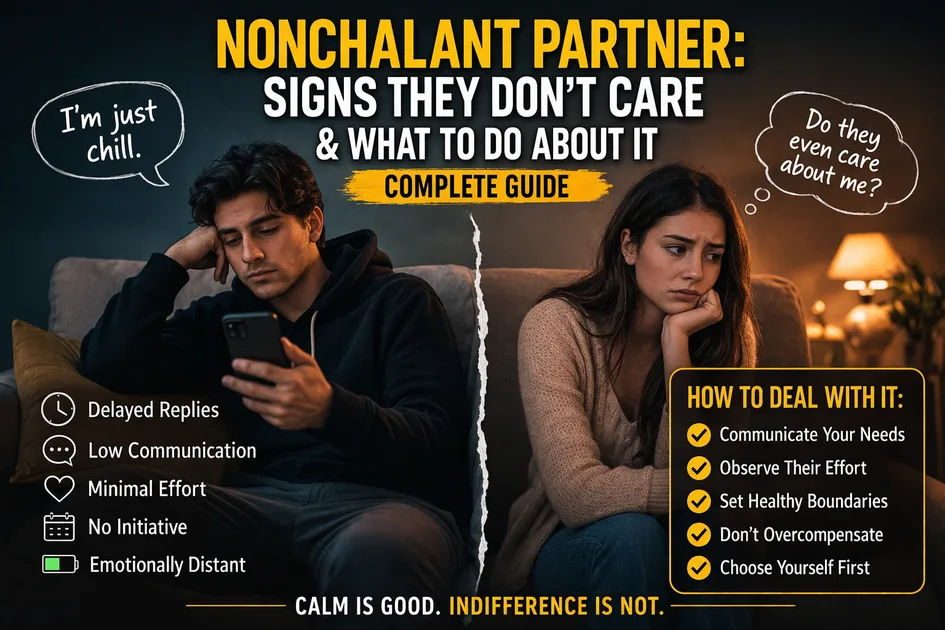
It can look like:
- Delayed replies
- Low emotional expression
- Lack of initiative
- Minimal effort
👉 The key question is:
Is it personality… or disinterest?
If you suspect emotional distance, this may explain it: 👉 Emotionally Unavailable Partner: Signs, Causes, and What to Do
⚖️ Healthy Calmness vs Problematic Nonchalance
| Healthy Calmness ✅ | Problematic Nonchalance ❌ |
|---|---|
| Emotionally stable | Emotionally distant |
| Communicates clearly | Avoids communication |
| Consistent | Unpredictable effort |
| Shows care quietly | Shows little to no effort |
Calm is good — indifference is not.
🚩 Signs a Nonchalant Partner Is Becoming a Problem
❌ 1. Lack of Effort
- They don’t initiate
- They don’t plan
Effort feels one-sided.
❌ 2. Poor Communication
- Short replies
- Avoiding deeper conversations
You feel unheard.
If communication feels weak, this will help: 👉 The Importance of Communication in Love (And How to Do It Right)
❌ 3. Emotional Distance
- Rarely express feelings
- Avoid vulnerability
Connection feels shallow.
❌ 4. You Feel Like You’re Asking for Too Much
You start thinking:
👉 “Maybe I’m too needy”
But your needs are valid.
❌ 5. Inconsistency
- Sometimes present
- Sometimes distant
This creates confusion.
❌ 6. They Don’t Prioritize You
- You feel like an option
- Not a priority
This affects your self-worth.
💔 Why Some People Are Nonchalant
Understanding helps — but doesn’t excuse.
🧠 1. Personality Type
Some people are naturally:
👉 Less expressive
💭 2. Fear of Vulnerability
They avoid:
👉 Emotional depth
💔 3. Past Experiences
They may:
👉 Protect themselves emotionally
🎭 4. Lack of Interest
Sometimes:
👉 They’re simply not fully invested
🛠️ How to Deal With a Nonchalant Partner
This is where you protect your emotional health.
✅ 1. Clarify What You Need
Ask yourself:
- What do I need to feel valued?
Be clear with yourself first.
💬 2. Communicate Your Needs
Say:
“I need more communication to feel connected.”
Be direct, not indirect.
⚖️ 3. Observe Their Response
Do they:
- Try to improve?
- Stay the same?
Actions matter more than words.
💪 4. Stop Overcompensating
Don’t:
- Chase
- Over-give
This creates imbalance.
🧠 5. Don’t Take It Personally
Their behavior may reflect:
👉 Their limitations — not your worth
🚫 6. Set Boundaries
Example:
“I need consistent effort in this relationship.”
Boundaries protect your well-being.
If setting boundaries feels difficult, this will help: 👉 How to Set Boundaries Without Hurting Your Partner (Complete Guide)
🛑 7. Know When to Walk Away
If:
- Nothing changes
- Your needs remain unmet
👉 You must choose yourself.
❤️ Can a Nonchalant Partner Change?
Yes — but only if:
- They are aware
- They are willing
- They make consistent effort
You cannot force this.
⚖️ Should You Stay or Leave?
Ask yourself:
- [ ] Do I feel valued?
- [ ] Is there effort?
- [ ] Are my needs respected?
- [ ] Do I feel secure or confused?
Your answers guide your decision.
🧾 Self-Check
Ask yourself:
- [ ] Am I settling?
- [ ] Am I constantly adjusting?
- [ ] Do I feel emotionally fulfilled?
- [ ] Am I ignoring how I feel?
Awareness brings clarity.
If you’re unsure whether this is a deeper issue, read: 👉 12 Signs You’re in a Toxic Relationship and What to Do Next
🧠 Final Thoughts
Being with a nonchalant partner is not about:
Changing them.
It’s about:
- Understanding the situation
- Protecting yourself
- Making the right decision
If you want to avoid this pattern in the future, this will help: 👉 How to Choose a Partner Who Won’t Waste Your Time (Complete Guide)
You deserve consistency, effort, and emotional connection.
💬 Let’s Talk
Do you think being nonchalant is a personality… or a red flag?
🔥 Key Takeaway
If someone consistently makes you feel like you’re too much — they may simply be giving you too little.
📚 Related Reads
- Emotionally Unavailable Partner: Signs, Causes, and What to Do
- The Importance of Communication in Love (And How to Do It Right)
- How to Set Boundaries Without Hurting Your Partner (Complete Guide)
- 12 Signs You’re in a Toxic Relationship and What to Do Next
- How to Choose a Partner Who Won’t Waste Your Time (Complete Guide)